Planning a multi-country trip is a completely different beast from planning a trip to one country. You have endless possibilities to work with, and the challenge is figuring out how to fit all the major pieces together: which countries to visit, where to start and end, and how to route the destinations. Get those pieces wrong, and you can end up with unnecessary backtracking, long travel days, or an itinerary that simply doesn’t work.
After traveling full-time for the past two years, I’ve gotten pretty good at planning trips with multiple destinations. I’ve developed a framework for figuring out where to go, how long to stay, and how to connect each stop without turning the trip into a convoluted mess.
This 5-step framework can be applied to any multi-country trip, whether you’re planning two countries or six. I’ll also walk through a real-life example using my recent East Africa trip, showing exactly how I used the framework to build the route.
Table of Contents
My 5-Step Trip Planning Framework
- Decide on your destinations and time frame.
- Choose your arrival and departure cities.
- Sequence the route.
- Schedule the big experiences.
- Fill in the gaps.
Step 1: Decide on your destinations and time frame
Start with the big picture: where do you want to go, when do you want to travel, and how much time do you actually have? Make a rough list of the countries and destinations that interest you. Then use the amount of time you have to determine how many destinations you can realistically fit into the trip.
Pro tip: Try to stick to destinations within the same region. Regional trips usually mean shorter flights, easier overland connections, fewer border crossings, and less time spent in transit. It also makes planning around the weather easier because neighboring countries often share similar seasonal patterns.
Some regional combinations I’ve traveled through include:
- Balkans & Mediterranean: Montenegro → Albania → Greece → Turkey
- Central Asia: Kyrgyzstan → Kazakhstan → Uzbekistan
- North Africa: Egypt → Tunisia → Morocco
Once you know when you’re going, where you’re going and how much time you have, you have a foundation for planning the rest of the trip.
Real-Life Example: East Africa Trip
For my East Africa trip, I knew I wanted to visit Ethiopia, Rwanda, Uganda, Tanzania, and Kenya. Each destination had something specific I wanted to experience, including gorilla trekking, climbing Kilimanjaro, going on safari, and time on the beach.
I decided to travel at the end of June because the timing worked well for the experiences I wanted to prioritize. I also had about five weeks available, which felt like enough time to experience the region without trying to cram too much into each day.
Translating this into actual dates, I would arrive June 25 and depart July 30 (or somewhere around there).
Step 2: Choose your arrival and departure cities
With your destinations set, figure out where the trip should begin and end. Look for cities with good international flight connections and use them as the bookends of your trip. In most cases, an open-jaw itinerary is better than flying in and out of the same city because you can travel in one direction without having to backtrack.
Real-Life Example: East Africa Trip
I decided to start in Addis Ababa, Ethiopia and finish in Nairobi, Kenya. Both are major international aviation hubs with plenty of connections outside East Africa. That gave me a natural route through the region without having to return to Ethiopia at the end of the trip just to catch my flight home.
Step 3: Sequence the route
Now it’s time to figure out the order in which you’ll visit each destination. This is usually the trickiest part because several factors need to work together.
Consideration 1: Design your route to minimize travel time
Your route should generally flow in one direction. For example, say the itinerary includes Lisbon, Barcelona, Paris, and Berlin, with Lisbon as the starting point. The most logical sequence would be Lisbon → Barcelona → Paris → Berlin. Each stop moves progressively east, keeping both travel time and unnecessary backtracking to a minimum.
Of course, multi-country trips won’t always be this linear. In such cases, look at the airports serving each destination and identify which cities have direct flights between them to avoid layovers.
Real-Life Example: East Africa Trip
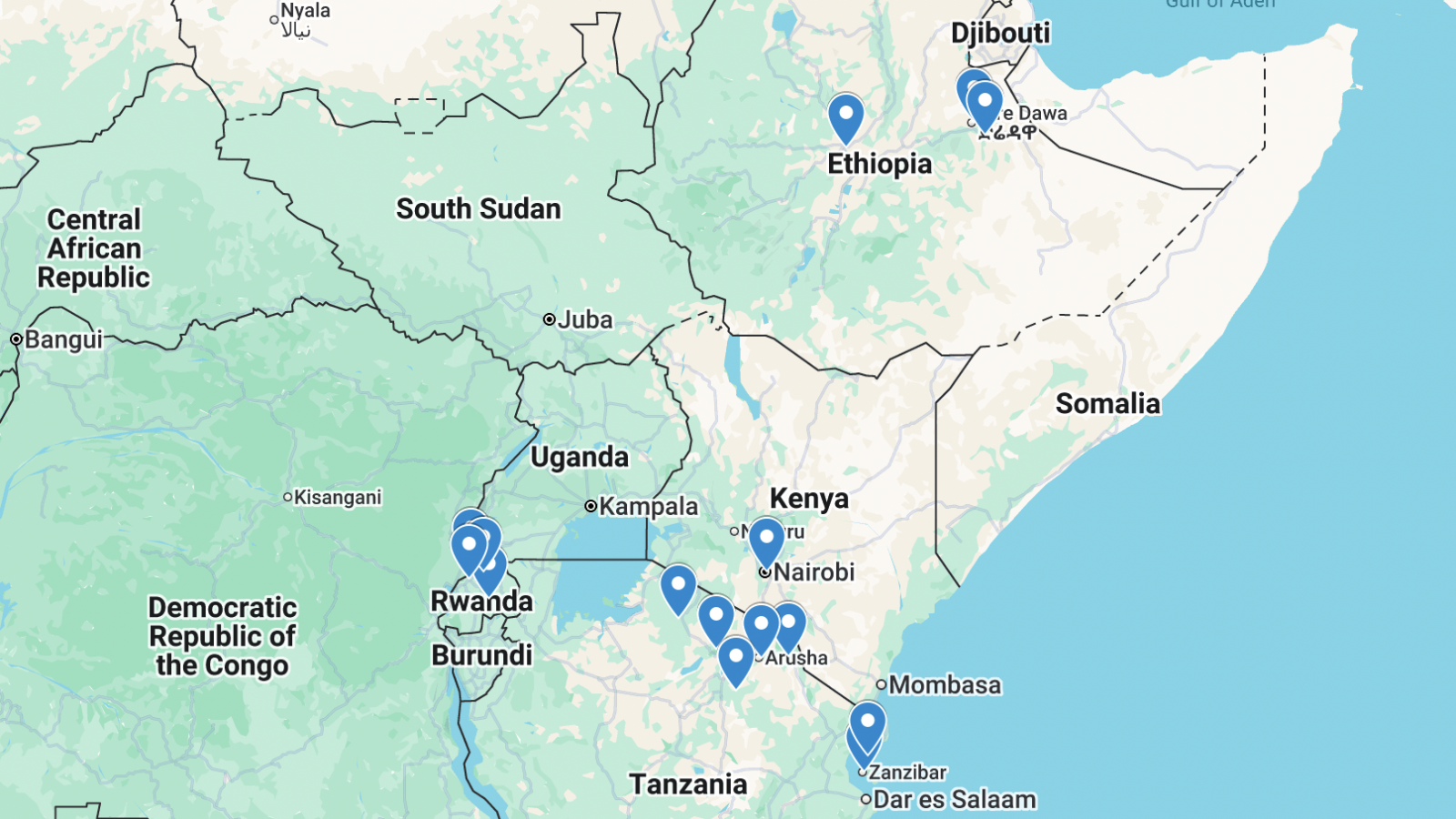
I now needed to connect Addis Ababa (ADD) and Nairobi (NBO) to the major destinations displayed in the map below.
That meant looking at the airports serving each part of the trip:
- Kigali (KGL) for gorilla trekking
- Kilimanjaro International Airport (JRO) for Kilimanjaro
- Arusha (ARK) for safari
- Zanzibar (ZNZ) for the beach portion
Kigali is in Rwanda, while JRO, ARK, and ZNZ are all in Tanzania. Since the goal is to minimize layovers, the first question is simple: which of these airports can be reached directly from Addis Ababa?
To find this, I use FlightConnections. By entering ADD in the “From” field, I can see which airports have direct connections from Addis Ababa. In this case, ADD connects directly to KGL, JRO, and ZNZ, but not ARK. That immediately rules out Arusha as the first stop after Addis Ababa if avoiding a connecting flight is a priority.
The same process can then be repeated for the other airports. Check which destinations have direct flights between them, eliminate combinations that require unnecessary connections, and gradually narrow down the possible routes.
For this itinerary, that left three potential sequences:
- Route 1: ADD → JRO (Kilimanjaro) → ARK (Safari) → ZNZ (Beach) → KGL (Gorillas) → NBO
- Route 2: ADD → ZNZ (Beach) → ARK (Safari) → JRO (Kilimanjaro) → KGL (Gorillas) → NBO
- Route 3: ADD → KGL (Gorillas) → JRO (Kilimanjaro) → ARK (Safari) → ZNZ (Beach) → NBO
At this point, the route has been narrowed down based on flight availability and direction of travel. We’ll take a look at other considerations that will help us pick the best route out of the three.
Consideration 2: Design your route around your activities
The order of destinations isn’t just about geography. Think about how physically and mentally demanding each part of the trip will be. You don’t want to arrive after a long-haul flight and immediately start a major physical challenge. You also don’t want to schedule several demanding activities back-to-back without giving yourself time to recover.
In addition, consider the overall arc of the trip. Some experiences are better suited near the beginning, while others make more sense at the end. For example, it might be a good idea to do a difficult trek earlier on and save relaxing on the beach toward the end.
Real-Life Example: East Africa Trip
Route 3, ADD → KGL (Gorillas) → JRO (Kilimanjaro) → ARK (Safari) → ZNZ (Beach) → NBO, makes the most sense based on the activities. There were a few reasons for this:
- I didn’t want to start with Kilimanjaro. I had just flown halfway around the world, so starting a seven-day mountain trek immediately would have been a rough introduction to the trip.
- Gorilla trekking made a good first major activity. It was physically demanding but much less intense than Kilimanjaro, giving me some time to adjust to the region before the biggest challenge.
- Safari came after Kilimanjaro. After nearly a week of hiking, sitting in a safari vehicle for a few days sounded pretty appealing and gave my legs time to recover.
- Zanzibar made a good finale. After weeks of trekking, hiking, game drives, and travel days, I wanted somewhere where I could slow down and actually relax.
Consideration 3: Look at prices and schedules for each route
A route that looks perfect on paper doesn’t necessarily work in practice. Once you’ve narrowed down the possible routes, check the actual transportation schedules, frequency, and prices for each one. For each route, look at three things:
- Frequency: How often does the flight or other transportation operate?
- Timing: Do the departure and arrival times actually fit your itinerary?
- Cost: How much does the entire connection cost?
With my East Africa example, Route 3 might look like the most logical route, but what if the flights are significantly more expensive than the alternatives? Or what if the ADD → KGL flight only operates once a week, making it difficult to fit into the itinerary? These practical details can turn an otherwise efficient route into an inconvenient or unnecessarily expensive one.
If the prices or schedules don’t work, go back to the other options. Sometimes the slightly less geographically efficient route ends up being the better choice because the transportation is cheaper, more frequent, or better timed.
Real-Life Example: East Africa Trip
Luckily, the prices and flight schedules worked out well for Route 3, so it remained the front-runner. At this point, I had a route that worked geographically, fit the activities in a logical order, and was actually feasible from a transportation standpoint.
Consideration 4: Look at visas and entry rules
Visa and entry rules can dictate the order of an itinerary. Some regional visas are designed to let travelers move between several neighboring countries, but stop working once the traveler leaves that region. That’s exactly what happened with the East Africa Tourist Visa on this itinerary.
Real-Life Example: East Africa Trip
The East Africa Tourist Visa (EATV) was another factor I had to consider. The $100 multiple-entry visa covers Kenya, Rwanda, and Uganda for up to 90 days. Crucially, Tanzania isn’t included, and once you leave the three countries, the EATV is no longer valid.
To take advantage of this visa, the Rwanda/Uganda and Kenya portions must happen consecutively. Routes 1 and 2 satisfy this criteria. On the other hand, Route 3 (the leading option), puts Tanzania in the middle:
ADD (Ethiopia) → KGL (Rwanda) → JRO/ARK/ZNZ (Tanzania) → NBO (Kenya)
This means I’d need to get a separate travel authorization to enter Kenya.
The takeaway on route sequencing
As my East Africa example shows, there’s rarely a single “perfect” route. Geography, flight schedules, prices, activity timing, and visas can all point toward different options. we therefore have to weigh the tradeoffs and choose the route that works best overall.
Real-Life Example: East Africa Trip
Ultimately, I decided to still go with Route 3 since it was the best option considering the various factors. The flight schedules worked and the activities were in a solid order. Having to pay a separate Kenya ETA was a worthwhile tradeoff.
Step 4: Schedule the big experiences
Now that the route is taking shape, it’s time to lock in the big experiences that will become the anchors for the rest of your itinerary.
Focus on experiences that are date-specific, have limited capacity, or are difficult to rearrange later. You don’t need to book every activity at this stage. The goal is to secure the experiences that could force you to change the rest of your itinerary.
Real-Life Example: East Africa Trip
The two biggest bucket-list experiences were gorilla trekking and climbing Kilimanjaro. I was traveling during the high season, so I needed to book both well in advance. Gorilla trekking permits are limited, while Kilimanjaro operators often have set departure dates for group climbs.
The availability of these two activities played a huge role in determining the route sequence. If I couldn’t get a gorilla permit during the first part of the trip, I would have had to move gorilla trekking later (i.e. choose Route 1 or Route 2 instead).
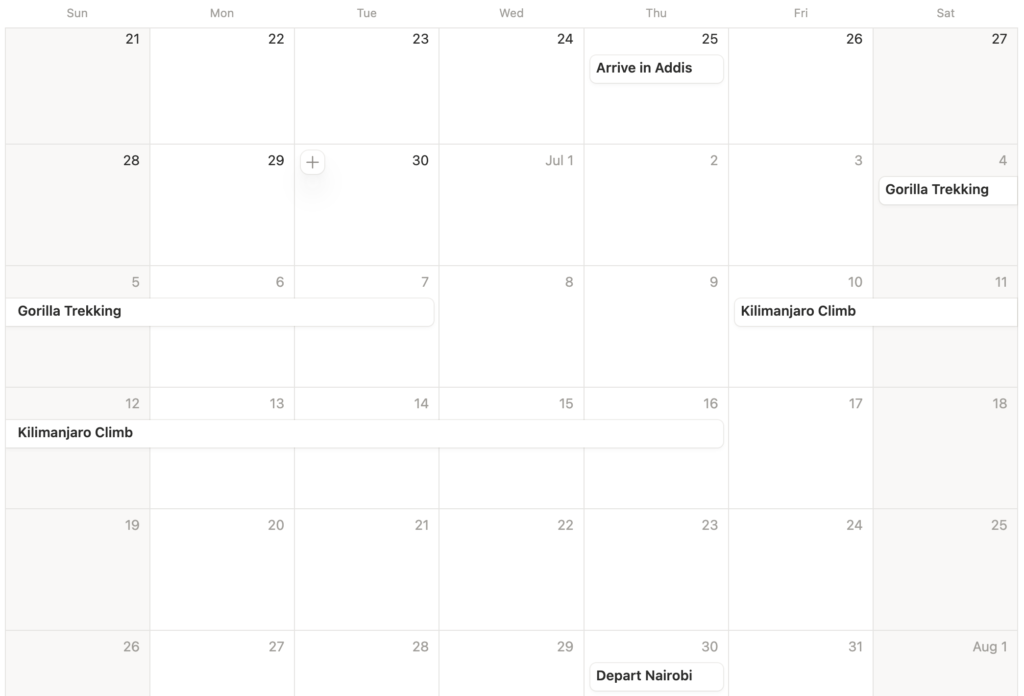
Luckily, I found availability, giving me the following dates around which to anchor my itinerary.
- June 25: Arrive in Addis Ababa
- July 4: Gorilla trekking
- July 10: Kilimanjaro climb begins
- July 30: Depart Nairobi
Step 5: Fill in the gaps
Once you have the dates for your arrival, departure, and major activities locked in, start filling in the gaps between them. Start by working outward from your anchor dates. If you have a major activity on Day 10, look at the days leading up to it and ask which destination makes the most sense beforehand. Then do the same for the days afterward. Continue filling in the gaps until you’ve accounted for the entire trip.
As you fill in the gaps, think about three things: where you want to go, how much time each destination deserves, and how much recovery time you need between major activities.
Pro tip: Build in buffer days. Don’t underestimate how tiring a multi-country trip can be. You’re combining physically demanding activities with border crossings, early mornings, and long travel days. You don’t need to fill every day of a five-week trip. Leaving some breathing room gives you time to recover, deal with unexpected delays, and actually enjoy the places you’re visiting.
Real-Life Example: East Africa Trip
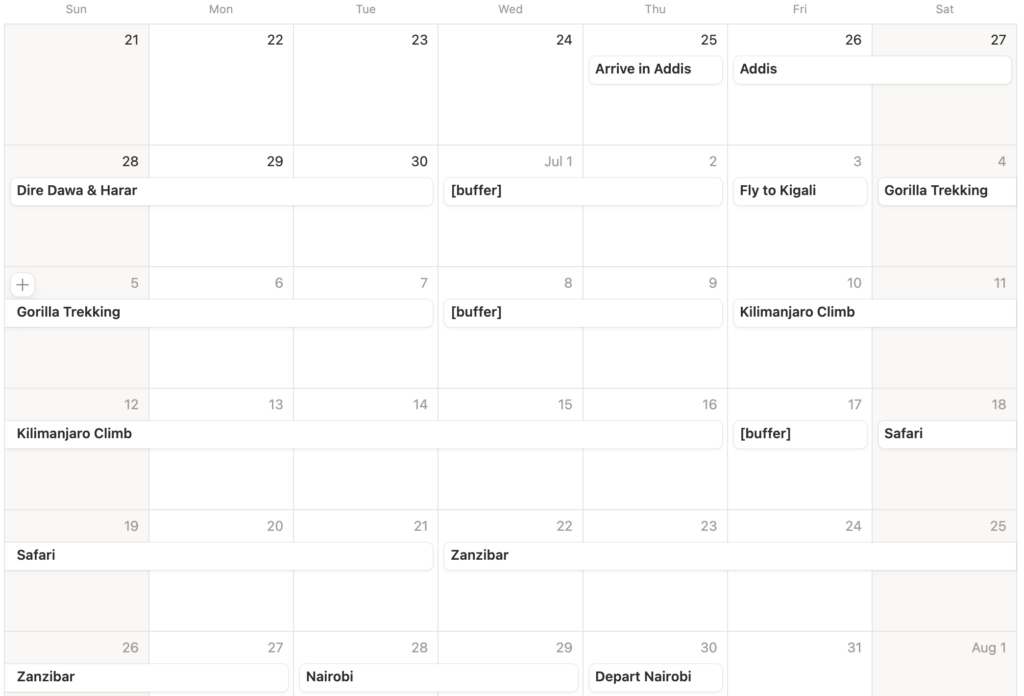
I used the week between arriving in Addis Ababa and my gorilla trek to explore Ethiopia. I spent a few days in Addis before heading east to Dire Dawa and Harar, then left myself two buffer days before traveling to Kigali.
I did something similar around Kilimanjaro. I had two rest days before the climb and another day afterward rather than scheduling another major activity immediately before or after a seven-day mountain trek.
The remaining gaps were easier to fill. I scheduled the safari after Kilimanjaro, followed by Zanzibar as the final relaxing stretch of the trip.
Final Thoughts
When you start planning a multi-country trip, the possibilities can feel endless. That’s where this 5-step framework comes in. You start with all those possibilities and gradually narrow them down based on your time frame, priorities, transportation, activities, and other practical constraints. Each step eliminates options that don’t work until you’re left with a few realistic routes to choose from.
By this point, you should have the basic structure of your trip: the major experiences are locked in, the destinations are connected, and you’ve left enough breathing room between them.
Now you can move on to the day-to-day planning: where to stay, how to get around, and what to do in each destination. That’s a separate part of the planning process, and I find it much easier to tackle those details once the overall route is already in place.
If you want to see where my East Africa itinerary landed, check out the finished version available soon where I detail the actual costs and logistics.